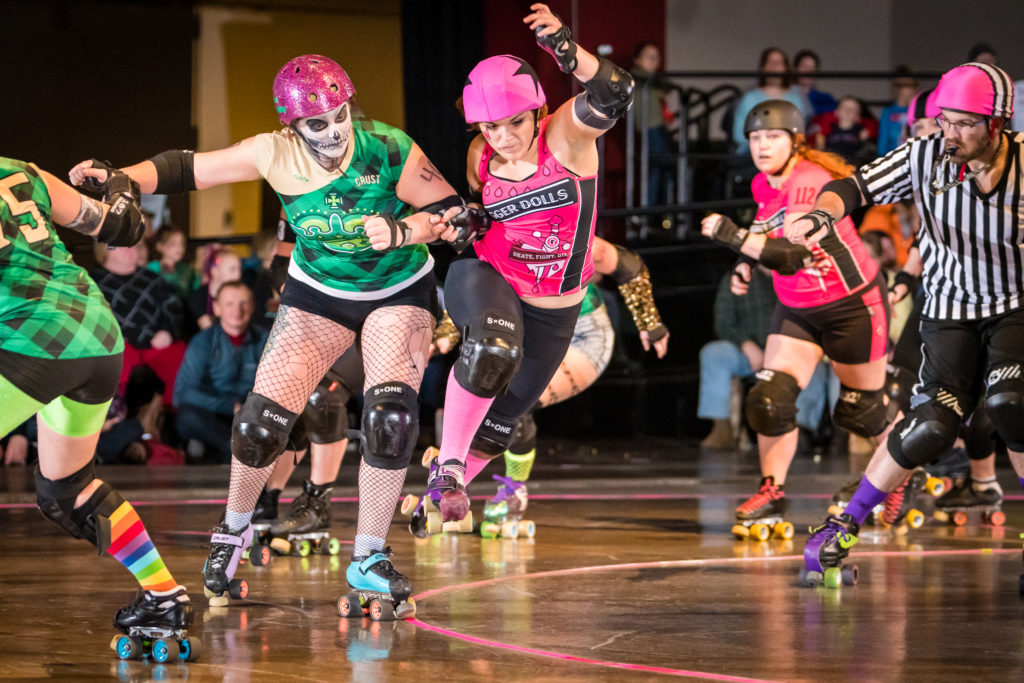
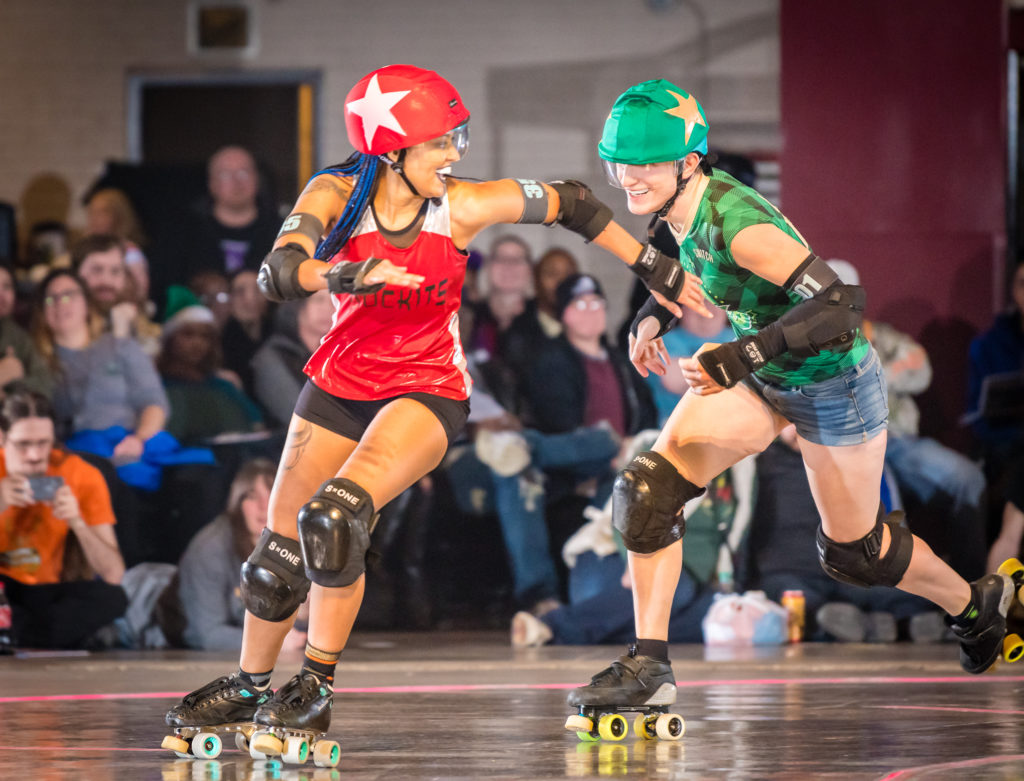
LISTEN UP, HERE’S HOW THE GAME IS PLAYED
The rules of Roller Derby are fairly complex until you’re familiar with them. To help you with that, we’ve put together this handy-dandy reference page. That way, you can really study things over and become a trackside expert. Then you’ll sound all smart when you’re sitting with your friends at the next bout. Now, the rules do vary a little bit from league to league, but these are the derby rules the Minnesota RollerGirls play by.

GAMEPLAY

Overview:
A bout consists of four twenty-minute periods during which multiple two-minute jams are played. During each period, two teams play each other. The teams that play the first period come back and play the third period. Likewise, the teams that play the second period return to play the fourth period. The score carries over from the first half to the second half, so the end score is cumulative for both periods played by one team matchup. To see what a jam looks like in action, click the Start the Jam button below. To learn more about the positions, roll over the symbols on the track for a description, and keep reading below for more detail about each position.

The jam:
A jam is a two-minute period of gameplay during which the pack skates around the track in a counter-clockwise direction while the jammers attempt to get through the pack to score points. To begin, the pivots and blockers line up in formation at the start line and the jammers line up at their start line, which is 20 feet behind the pack start line. The teams have 20 seconds to get their teams into formation. If a team takes longer than 20 seconds to get their players out, the jam starts anyway and that team plays without that player or players for the duration of the jam.

The referees set their jam timers to two minutes, and a single whistle is blown to indicate the start of the jam. With this whistle blow, the pack starts moving around the track, but the jammers stay in position. Twenty seconds later, the referees blow a double whistle to start the jammers skating. The jammers then take off from a dead stop to catch up to the pack and make their way through it.

The jammer who makes it through the pack first while passing the pivot in-bounds is awarded lead jammer. The referee who is following that jammer indicates that she is lead jammer by blowing their whistle and pointing to that jammer for the duration of the jam. By obtaining lead jammer, that jammer (and only that jammer) may call off the jam at any time. Calling off the jam stops the jam and the clock before the two-minute limit. This is done for strategic reasons and is indicated by the lead jammer putting her fists onto her hips with her elbows pointing out.

Stopping a jam:
Even though a jam is a maximum of two minutes, jams do not always go their full length. This is why there can be more than ten jams in a period, and there are often many more than that. The end of a jam is indicated by four quick blasts of the head ref's whistle. Here's how a jam can be ended:

  • Two-minute jam clock runs out
  • Lead jammer calls off jam (see above)
  • Fight breaks out
  • Skater injury (if a skater can pull themselves off the track, play can continue)
  • Debris on track
  • Skate breakdown (e.g., wheel falls off)
  • Period ends

POSITIONS

Pivot, helmet cover with stripe
The pivot is the pack’s pacesetter and each team’s last line of defense. Each team has a pivot who is usually leading her pack. It is legal for blockers to go in front of their pivot, but they cannot go more than 20 feet in front of her. Pivots are responsible for keeping the pack together, calling out plays, and blocking or holding up the opposing jammer as much as they possibly can. Often, a pivot will work with a blocker from her team, forming a wall at the front of the pack. Occasionally, you’ll see a pivot become a jammer. This is done in the first pass through the pack when the starting jammer hands off her helmet cover. In this case, the pivot then becomes the jammer and another team member steps up as pivot. If a pivot is in the penalty box, play continues and her team plays one player short.

Blocker, no helmet cover
Blockers do just that; they block. This position is both defensive and offensive. The main goals of a blocker are to slow down or knock out of bounds the opposing jammer and to clear a path for their own jammer. Blockers do this by knocking people down, forcing them out of bounds, and just generally getting all up in their opponents faces in order to create a good outcome for her own team. If a blocker is in the penalty box, play continues and her team plays one player short.

Jammer, helmet cover with star on each side
The jammer is the point scorer. Jammers are the only team members who can score points, and they do so by passing opponents while inbounds. For each opponent passed (either on the track or in the penalty box), the jammer gets one point as long as she did not have a foot out of bounds on the ground. They can go out of bounds, but they don't score points for any opponents they pass while out of bounds. If a jammer is in the penalty box, play continues and her team plays without their jammer. If one jammer is in the box, you'll see the opposing team take off in a race to try to outpace the remaining jammer. This is because as long as they can stay in front of her, she can't score.

FORMATION

In order for a jam to begin, the skaters must get into pack formation on the track. The pack consists of one pivot, three blockers, and one jammer from each team for a total of up to 10 players on the track at a time. We say "up to" because it is possible to play with fewer players due to penalties being served. See below for more information about penalties. Once the jam starts, the pack is defined as being in existence once the last blocker crosses the pivot line.

Illustration of pack formation
WHAT'S LEGAL, AND WHAT'S NOT

IT'S LEGAL...

  • To engage another player (block them).
  • To block from the side or in front of opposing players.
  • To use the shoulders or hips to block opposing players.
  • To block from either lateral direction (from the inside -> outside or from the outside -> inside.
  • To push or whip (grab with one hand each and thrust the back person forward) your own players.
  • To block the jammer like any other player.
  • For the jammer to go out of bounds, as long as she is in-bounds when passing players during the first time through the pack. If she does so during that first time through, she cannot earn lead jammer status.
  • For the jammer to engage players under the same rules as blockers including engaging the other jammer.
  • For the members of the pack to go in front of their own pivot, but no more than 20 feet.
  • For the members of the pack to engage another player while behind the pack, but no more than 20 feet behind.

IT'S ILLEGAL...

  • To fight with another player.
  • To block from the back of an opposing player.
  • To engage a player after the jam whistle has blown.
  • To use elbows or hands in any way on an opposing player (as in an elbow jab).
  • To block an opposing player while out of bounds or when the opponent is down.
  • To push an opposing player in any way by using hands, forearms, or elbows.
  • To trip or use the feet in any way (as in a wheel lock).
  • To intentionally fall.
  • For the jammer, or any other player, to cut the track (cross through the center), in order to catch up with or pass the pack.
  • For the jammer to intentionally go out of bounds in order to go through the pack faster.
  • For the members of the pack to engage any other player while more than 20 feet in front of or behind their own pivot.

PENALTIES

Penalties are used to punish teams and players for disobeying the rules of engagement. Penalties are cumulative over the course of a bout (each player's penalty total carries over from period to period), but they are not cumulative for the season. If there are more than two players from a team with penalties, the third person may skate until the first penalty time is up so that no team is down by more than two skaters at a time.

There are two types of penalties that are dished out during gameplay: minor and major.

MINOR PENALTIES
A minor penalty is assessed for an infraction that does not have serious consequences on safety or gameplay.

  • Fighting between two skaters that does not injure another player and does not involve illegal actions (see Fighting at right).
  • Any form of illegal blocking which is not deemed a serious threat to other skaters.
  • Blocking or assisting outside the pack.
  • Intentionally cutting the track.
  • Intentionally skating out-of-bounds.

Minor penalties are voiced by the ref to the skater as a warning and tracked by the stats ref. If a skater gets four minor penalties, she's sent to the penalty box to serve one minute. She cannot be replaced by another skater from her team during this time and her team skates short until her penalty time is complete.

MAJOR PENALTIES
A major penalty is assessed for an infraction that has serious consequences on safety or gameplay.

  • Fighting that involves only one player (other player doesn't participate in the fight) or involves the use of illegal moves such as hits to the face, pulling of the helmet or chin strap in order to choke, any type of kicking, dog-piling, or biting.
  • Gross unsports-lady-like conduct.
  • Intentional interference in gameplay by skaters not involved in the jam.
  • Excessive insubordination to a referee.
  • Any form of illegal blocking which is deemed a serious threat to other skaters, such as blocks falling above the shoulders or below the hips.
  • Disregard of the rules (demonstrated by repeated minor penalties).

Major penalties result in the player going immediately to the penalty box and sitting out for two minutes. She cannot be replaced by another skater from her team during this time and her team skates short until her penalty time is complete. Each skater can get a maximum of three major penalties per bout; on the fourth, the skater is expelled from the bout.